
The blue whale (Balaenoptera musculus) is the largest animal known to have ever existed on Earth. It belongs to the rorqual family (Balaenopteridae), which also includes humpback, fin, sei and minke whales. In the Gulf of California, and particularly in Loreto Bay, this species finds one of its most important habitats for feeding, breeding and calving.
Biology and physical characteristics
Blue whales are marine mammals with an elongated, streamlined body, adapted to travel long distances between feeding and breeding areas. Their cruising speed is around 20 km/h, but they can reach higher speeds over short distances.
A female blue whale can measure more than 30 meters in length and weigh up to 190 tons, equivalent to approximately 38 African elephants or the length of a Boeing 737 aircraft. Calves are born weighing between 2.5 and 4 tons and increase in size up to 30 times during their first year of life.
Their skin is silvery gray to blackish gray, with mottled patterns that are unique to each individual and allow identification through photo‑identification. Underwater, their coloration can appear pale blue or aquamarine. On the ventral side, they have longitudinal grooves that allow the throat to expand enormously while engulfing large volumes of water and prey.
Like other rorquals, the blue whale has jet‑black baleen plates instead of teeth. These baleen plates can measure up to one meter in length and function as a filter: the whale takes large mouthfuls of prey‑laden water and then expels the water while retaining the krill and other organisms.
Feeding and ecology
The blue whale is a krill specialist, feeding on small shrimp‑like crustaceans that form large swarms in the Gulf of California. A blue whale weighing around 80 tons may need between 2 and 3 tons of food per day, equivalent to millions of krill.
To feed, blue whales usually dive between 40 and 200 meters deep, although they can reach depths of up to 500 meters. They range over vast areas in search of krill “hot spots,” and when they find an abundant resource, they may remain feeding in that area until it is depleted.
There is evidence that when they find a food resource much larger than the needs of an individual or a small group, blue whales use their low‑frequency calls to “call” other individuals. Researchers describe this behavior as a form of “reciprocal altruism,” in which favors may be returned in the future.
Blue whales produce the loudest sounds of any animal. Their low‑frequency calls can be detected more than 1,000 kilometers away under ideal conditions, allowing them to communicate across enormous stretches of ocean.
Life cycle and reproduction
Blue whales are long‑lived animals: they can live around 90 years. They move between feeding areas in the northern hemisphere during the summer and breeding and calving areas in the southern hemisphere during the winter. In the Gulf of California, however, research by Dr. Diane Gendron and her team has shown that some blue whales also feed actively during the winter, breaking with traditional assumptions.
Females give birth to a single calf after a gestation period of approximately 11 months. Calves remain with their mothers during the first year of life, feeding on maternal milk and learning to move and feed on their own.
Conservation status and threats
Globally, the blue whale is classified as Endangered. Intensive whaling during the 20th century drove this species to the brink of extinction. Although commercial whaling for blue whales has been prohibited since the 1960s, population recovery has been slow.
Contemporary threats include:
- Climate variability and change, which can alter ocean productivity and krill availability.
- Ocean acidification.
- Noise interference from marine industry and shipping.
- Habitat modification and disturbance from vessels, including the risk of ship strikes.
- Overexploitation of prey species, especially krill.
In the Gulf of California, the growth of whale watching tourism represents both an opportunity and a challenge. If not managed properly, the presence of many vessels can disturb whales, affect their feeding and increase the risk of collisions.
The blue whale in Loreto Bay
Long‑term research by Dr. Diane Gendron and her team has shown that Loreto Bay is a crucial area for the blue whale in the Gulf of California. Thanks to more than 35 years of work, more than 800 individuals have been identified through photo‑identification, long‑term databases of sightings and biological samples have been built, and the patterns of distribution, feeding and reproduction of this species are better understood.
Dr. Gendron’s studies have revealed that, in Loreto, blue whales do not only spend the winter to reproduce, but also feed actively. This has led to the conclusion that the Gulf of California is a zone of breeding, feeding and reproduction for the blue whale, a finding that changed the traditional understanding of this species.
In addition, research on whale behavior in the presence of vessels led to the development of the Passive Observation method, in collaboration with local tour operators in Loreto. This method consists of turning off the engine when whales are sighted, not chasing them and respecting minimum distances. Results show that, when the engine is off, whales dive longer at the surface and are less disturbed, benefiting both the animals and the visitors’ experience.
An ecosystem that protects the whale
The presence of blue whales in Loreto Bay is an indicator of the health of the Gulf of California ecosystem. For these whales to find enough food, there must be an abundance of krill, and for there to be krill, there must be a productive sea, with healthy phytoplankton, good oceanographic conditions and a lightly disturbed coastal environment.
Protecting the blue whale in Loreto depends not only on laws and protected areas, but also on the practices of the local community. Tour operators, fishers and residents of Loreto play a key role in maintaining this refuge, through Passive Observation, responsible tourism and care for the marine and coastal environment.
In this context, the blue whale is more than an emblematic species: it is a reminder that the Gulf, the islands, the desert and the people of Loreto form a single ecological and social system, where nature conservation and community well‑being are deeply connected.
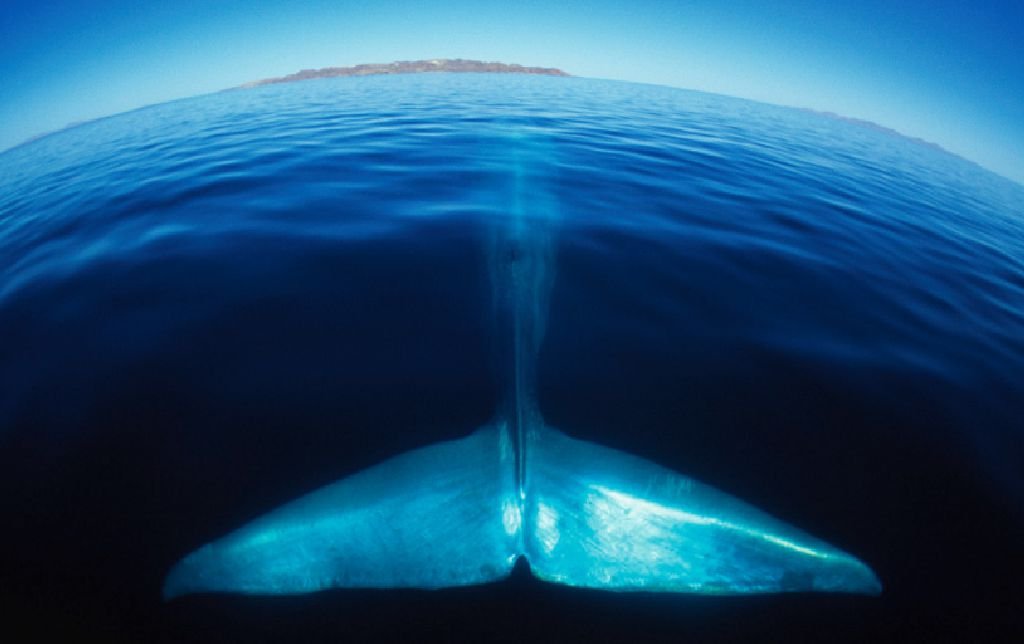
The Blue Whale
The blue whale is the emblem of a healthy marine ecosystem.